Our platform · Interactive crossbench desk
Make NSW’s Upper House the Citizens’ House of Review
Defending statewide proportional representation and making the NSW Legislative Council work as the citizens' house of review — orders for papers, delegated legislation, committees and the 4.55% quota.
4.55%
about that share of the statewide vote elects a member — the quota that keeps the crossbench open, low enough for genuinely diverse representation, high enough to require real community support
48%· 20% opposed
said a citizens’ assembly is a good idea for Australia — the most popular of four democratic reforms polled
17years
Elisabeth Kirkby in the Legislative Council — for much of that time sharing the balance of power, judging each government’s legislation on its merits
Every figure above is quoted from the policy text below — the quota of about 4.55%, the 2025 Australian Election Study polling on a citizens’ assembly, and Elisabeth Kirkby’s seventeen years in the Legislative Council. Nothing here is estimated, rounded or inferred.
Interactive · The crossbench desk
Neither a rubber stamp nor a wrecking ball
Why bother? Because only 32% of Australians say people in government can be trusted, while 68% say they look after themselves (part 01). A crossbench elected on a 4.55% quota is the answer this state already has — if it is used. Below is one sitting day, worked all the way through: every instrument run, every finding on the record, and the division published. A bill has landed on your desk. Run the scrutiny instruments in any order, then vote. All three verdicts are live from the moment the bill arrives.
Legislative Council · order of business
A bill, as introduced
Schematic, and deliberately unnamed: a title page, a run of clauses and a schedule. What it does to people is in the papers nobody has tabled yet.
Papersproduced in full, on time
The instruments — the plan in part 02
Three powers the Council already has, and each one puts something on the public record. All three were run before this page was printed. Run them in any order — tap, click, or press Enter or Space.
- Claim of privilege — everything The order is met with delay, resistance and one sweeping claim over the lot.
- Independent arbitration An independent arbiter assesses the disputed claim, document by document. The blanket falls away.
- Papers produced — in full, on time A house of review that cannot see the documents cannot review anything. Now it can.
“Egan v Willis (1998) confirmed that the Council’s power to order the production of state papers — and to sanction a minister who refuses — is reasonably necessary to its function of holding the government to account, and Egan v Chadwick (1999) mapped the limits around Cabinet documents and legal professional privilege, with disputed claims assessed through an independent arbiter.” part 03 · the evidence
Response due — on time Enforced timeframes for government responses. Overdue responses debated in the House. Follow-up reviews that check whether accepted recommendations were actually delivered.
- Findings on the record
- Recommendations tracked
“Legislative Council committees can compel evidence, travel the state, and put ministers and officials on the public record — but their reports too often draw late or pro-forma responses, and there is no systematic check on whether accepted recommendations are ever delivered.” part 03 · the evidence
12 of 12 seats filled — panel size illustrative. The plan supports randomly selected panels, given time, evidence and independent facilitation, to advise the Council’s review of contested legislation.
A good idea for Australia 48%
Opposed 20%
“It is the democratic reform Australians support most: 48% backed a citizens’ assembly in the 2025 Australian Election Study, with only 20% opposed.” part 03 · the evidence
What we now know
4 of 4 findings on the record
- Papers produced — in full, on time
- Findings on the record
- Recommendations tracked
- A citizens’ jury deliberated
Empty. Nothing has been produced, found or deliberated on yet — vote now and citizens learn nothing.
It stays chained. The plan is to “judge every bill on its merits, negotiate amendments in the open, and never trade votes on unrelated measures behind closed doors.” part 02 · the plan, point 5
The verdict — three ways to use the balance of power
Two of these tell citizens nothing. The third is the one this policy argues for, and it is the one printed below. Nothing stops you voting right now, with an empty tray. That is the point: the power is real either way — it is what you do with it that differs.
A full sitting day: papers produced, committee reported, jury seated — and the division published. This is the desk working as it should.
Passed. Unread.
Passed, unread — 0 of 4 findings on the record.
The bill is law and nobody outside the room knows what it does. No papers were called for, so the two honest limits never had to be argued; no committee reported, so nothing was compelled onto the record; no citizen was asked. This is the chamber the numbers in part 01 are describing.
The work was done and the vote ignored it. Findings sitting in the tray change nothing until they are put to the House as a question someone has to answer for. Scrutiny that never reaches a division is a filing exercise.
“The Legislative Council at its best is neither a rubber stamp nor a wrecking ball, but the citizens’ house of review.” part 05 · the lineage
Blocked. Also unread.
Blocked, unread — 0 of 4 findings on the record.
Obstruction is not scrutiny. A crossbench that blocks without reading has told citizens exactly as much as one that waves things through: nothing. The balance of power is real power — and this is the use of it that hands the next government its argument for engineering the crossbench out of the chamber.
Blocking on principle throws away the one thing that was worth having: a record. The findings never became questions, the questions never became a division, and citizens are left with a result and no reasons. That is the argument the next government will use for engineering the crossbench out of the chamber.
“The Legislative Council at its best is neither a rubber stamp nor a wrecking ball, but the citizens’ house of review.” part 05 · the lineage
The House divides — and you can follow it
Divided on the merits — 4 of 4 findings on the record.
Amendments were moved in the open and each question was put separately, so the record shows who voted, how, and on what — alongside a plain-language summary of what the committee found.
| On what — the question before the House | Government | Opposition | Crossbench | Result |
|---|---|---|---|---|
| That the papers ordered be produced in full, and published | Not content | Content | Content | Agreed to |
| That the committee’s findings be entered on the record before the vote | Content | Content | Content | Agreed to |
| That the government report back on every accepted recommendation | Not content | Content | Content | Agreed to |
| That the citizens’ jury’s advice be considered before the final vote | Not content | Divided | Content | Agreed to |
Nothing on the record to divide on. The House can still divide — but with an empty tray, a published vote tells citizens who won, never why. Run an instrument and try again.
“A crossbench elected on a 4.55% quota holds real power — and using that power responsibly, transparently and on the merits is how trust is rebuilt.” part 04 · the conclusion
Schematic blocs, not members: no MLC is named or invented here, and no vote counts are guessed at. The questions are the plan’s own commitments, put one at a time.
A schematic sitting day. The instruments are the plan in part 02 and every figure quoted comes from the policy text; the bill, the blocs, the division and the size of the jury panel are illustrative. No real bill, division, member or panel is depicted.
The problem
The issues
The 2025 Australian Election Study found that only 32% of Australians trust government, and although satisfaction with democracy remained relatively stable (70%), it is clear from such surveys that Australian voters have become cynical about the motives of our elected representatives.
More specifically, of the 2,070 Australians surveyed, 68% felt “people in government look after themselves” while only 32% agreed with the statement “people in government can be trusted”.
The study also found that “Millennials [born between 1981 and 1996] are the least trusting of government, while the Baby Boomer generation [born between 1946 and 1964] has higher levels of overall trust.” The study also gauged support for four democratic reform options. The most popular option was to create a Citizen’s Assembly, “a body made up of randomly selected citizens who consider important policy issues and advise the government.” 48% of respondents said this was a good idea for Australia while 20% opposed, with 32% undecided.
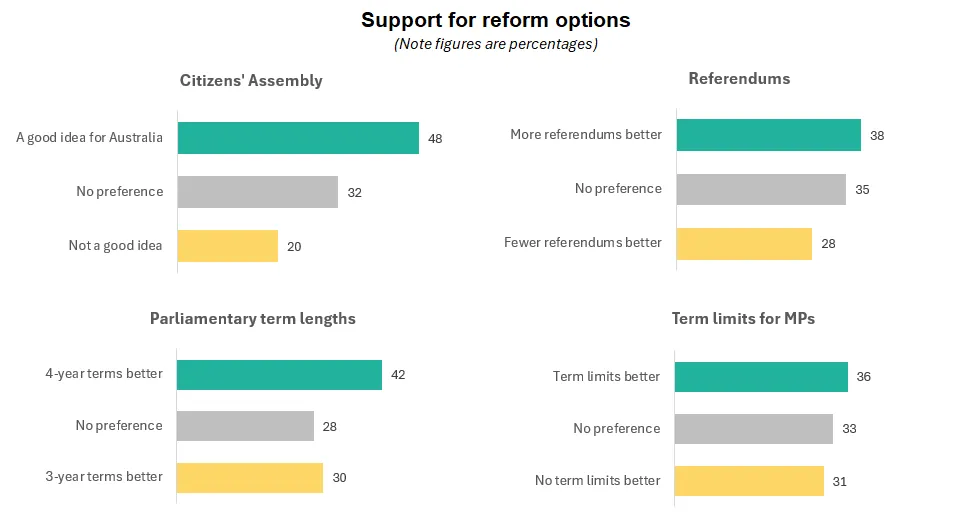
Figure 1: Responses to the four democratic reform options polled in the Australian Election Study. Source: The 2025 Australian Federal Election: Results from the Australian Election Study (PDF), Figure 5.6.
Distrust is only half the story, and it is the less structural half. The same study records a long, steady detachment from the party system itself: the share of Australians reporting no closeness to any political party rose from 14% in 2010 to 25% in 2025, a group now larger than the share identifying as Liberal partisans, at 24% (Australian Election Study, 2025). Satisfaction with democracy fell to 59% in 2019 — its lowest reading since the constitutional crisis of the 1970s — recovered to 70% in 2022 and held there in 2025, still well below the 78% recorded in 1996 and the 86% recorded in 2007 (Australian Election Study, 2025). The proportion of Australians who say they would still turn out if voting were voluntary has fallen to a record low of 74% (Australian Election Study, 2025). These are national figures drawn from a federal election study, not New South Wales figures.
That combination matters for an upper house more than for any other institution. A quarter of the electorate with no party attachment is not a protest; it is a durable feature of the electorate that a two-party chamber cannot represent and a proportional chamber can. Australian State and Territory Governments all grapple with declining trust in government. New South Wales, however, starts from a structural head start that most states lack.
The NSW Legislative Council — the state’s upper house — already has the architecture of a citizens’ chamber. It has 42 members, all elected from the state as a whole, with 21 elected at each four-year election for overlapping eight-year terms.
That architecture was chosen, not inherited. The 1991 referendum restructured the Council so that its members span two Assembly terms rather than three, which lifted the number elected at each election from 15 to 21 and, in doing so, cut the quota from 6.25% to 4.55%. The first election of 21 members was held in 1995 (NSW Parliamentary Research Service, 2026). The low quota that defines the modern Council is therefore the deliberate product of a question put to the people of New South Wales and carried — which is worth remembering whenever somebody proposes to raise it by ordinary legislation.
Electing 21 members statewide produces a quota of about 4.55% (the portion of votes a candidate needs to be elected). It is a hard number rather than a figure of speech: the quota is the total formal vote divided by 22 — one more than the number of vacancies — which at the 2023 election came to 209,858 votes, and which will be several thousand votes higher in 2027 as the roll grows (NSW Parliamentary Research Service, 2026). That low quota is why the Council routinely includes voices well beyond the two major blocs, and why governments must negotiate with a crossbench to pass legislation. And since the reforms that followed the infamous 1999 “tablecloth” ballot paper, voters — not party machines — control preferences: group voting tickets are gone, a single “1” above the line elects only that group’s own candidates in the order listed, and above-the-line voting is optional preferential — one square is enough. Below the line is different: there you must number at least 15 candidates, consecutively from 1, or the ballot is informal (NSW Electoral Commission, n.d.).
Voters have taken that power up, and they have taken it up faster than most commentary allows. Ballot papers marked with a single “1” above the line accounted for 82.2% of votes in 2011 and 83.0% in 2015 — but 69.7% in 2019 and 60.9% in 2023. Over the same period, above-the-line votes carrying preferences rose from 15.6% and 15.3% to 27.6% and 36.8%, a shift attributed to voters’ growing familiarity with the reformed Senate system since 2016. Only 2.3% of 2023 ballots were completed below the line, and below-the-line marking was rarest among supporters of the major parties — 1.4% for Labor and 1.0% for the Liberals and Nationals (NSW Parliamentary Research Service, 2026). A reform sold in 1999 as handing preferences back to voters is, twenty-four years later, being used by more than a third of them.
The arithmetic that results is not theoretical. As at June 2026, neither major bloc held a majority in the 42-member Council: Labor had 15 members and the Coalition 14 (Liberal 10 and Nationals 4), with a crossbench of 13 spread across the Greens (4), four independents, the Shooters, Fishers and Farmers (2), Legalise Cannabis (1), the Libertarian Party (1) and Animal Justice (1). One Nation had no members, having lost Mark Latham and Rod Roberts to resignations from the party in August 2023 and Tania Mihailuk in December 2024; Taylor Martin was expelled from the Liberal Party in April 2024 (NSW Parliamentary Research Service, 2026). Composition of this kind changes with resignations and casual vacancies, so the detail dates quickly — but the structural point does not. On any contested vote, the Government of the day must persuade people it does not control.
So for New South Wales the question is no longer which electoral system to adopt. It is twofold:
- Keep what works: 21 members elected at each election by statewide proportional representation, with preferences controlled by voters alone
• This produces a quota of about 4.55% — low enough for genuinely diverse representation, high enough to require real community support
- Make the chamber work as the citizens’ house of review: committees with teeth, orders for papers that are obeyed, votes citizens can see, and the public invited into scrutiny
• This is where New South Wales still falls short
The rules that should deliver the second half are already written. Standing order 240(1) requires the Clerk to refer any committee report recommending government action to the Leader of the Government, who must report to the House within three months what action, if any, the government proposes to take on each recommendation. Standing order 68(4) requires ministers to answer written questions within 15 business days, and standing orders 68(6) to 68(7) build in escalation: if an answer is late the President informs the House on the next sitting day, the minister must immediately explain the non-compliance, and if nothing arrives within three further sitting days the cycle repeats until an answer is produced (Legislative Council, 2023). A chamber does not construct that machinery unless it has needed it. The problem in New South Wales is not the drafting. It is compliance.
Orders for the production of state papers — a power the Council fought for and won in the Egan cases of the 1990s — are still met with delay, resistance and sweeping claims of privilege. Over the course of 2026 that dispute escalated to the repeated suspension of ministers from the House (Department of the Legislative Council, 2026), which is a measure of how far ordinary compliance has broken down rather than a sign of a system working.
On transparency, the gap is narrower than it is often described, and it is worth being accurate about what already exists. The Parliament publishes a searchable questions and answers tracking database covering both Houses, filterable by the date a question was asked, the date its answer falls due, its status, the portfolio and the asking member — so an overdue ministerial answer is already publicly identifiable. The Minutes of Proceedings, the official record of the Council’s proceedings, are published at the conclusion of each sitting day and are available online across more than a century of sessions, recording motions moved, the progress of bills and how members voted in each division (Parliament of NSW, 2026c). What is missing is not the underlying data but the aggregation: there is no consolidated, per-member voting record, so following how your own MLC votes across a session still means reading sitting-day documents one at a time.
And periodically, those inconvenienced by a strong crossbench float “reforms” — raising the effective quota, tightening registration rules, or reviving ticket voting — that would quietly engineer the diversity back out of the chamber. The next test comes soon: twenty parties were registered by the March 2026 deadline to contest the 2027 State election, on a ballot paper that will carry party logos for the first time and a polling day the Government has announced it intends to bring forward by a fortnight (NSW Parliamentary Research Service, 2026; Parliament of NSW, 2026a). Section 3 sets out what those settings do to who can realistically stand.
The plan
Our Plan
• Defend the Legislative Council’s statewide proportional representation — the low quota, optional preferential voting and voter-controlled preferences — against any attempt to raise the bar for new voices, revive group voting tickets, or engineer the crossbench out of the chamber.
• Strengthen the Council’s committee system so inquiries have teeth: enforcement of the three-month response obligation in standing order 240, debate of overdue and pro-forma responses, and follow-up reviews that track whether accepted recommendations were actually implemented (Legislative Council, 2023).
• Enforce the Council’s orders for the production of state papers — the powers confirmed in the Egan cases — with timely and complete compliance, and full use of the independent legal arbiter mechanism that already exists in standing order 52, including publication of an arbiter’s report where the House so orders (Legislative Council, 2023).
• Settle the Cabinet-in-confidence question by referring it to independent counsel rather than leaving it to the party claiming the privilege — the approach the House itself began testing in June 2026 (Department of the Legislative Council, 2026).
• Restore the Council’s power to compel the attendance of witnesses on a footing the courts will accept, following the Court of Appeal’s December 2025 decision striking down sections 7 to 9 of the Parliamentary Evidence Act 1901 (NSW Legislative Council, 2026).
• Resource the committee system and the Delegated Legislation Committee to the workload they actually carry, so that technical scrutiny of every disallowable instrument is a real check and not a formality (Department of the Legislative Council, 2025).
• Widen access to Parliamentary Budget Office costings beyond the two-policy cap now available to minor party and independent members, and beyond the requirement that a party already hold a seat to qualify at all (Parliament of NSW, 2026a).
• Support citizens’ juries and deliberative panels, convened to advise the Council’s review of contested legislation — the democratic reform Australians rated most highly in the 2025 Australian Election Study (Australian Election Study, 2025).
• Use the crossbench balance of power responsibly: judge every bill on its merits, negotiate amendments in the open, and never trade votes on unrelated measures behind closed doors.
• Make the chamber transparent: build on the Minutes of Proceedings and the questions and answers tracker the Parliament already publishes by adding an aggregated, per-member voting record citizens can actually follow — who voted, how, and on what — alongside plain-language summaries of what committees found (Parliament of NSW, 2026c).
The evidence
The Evidence
There is not strict “right” and “wrong” when it comes to considering electoral systems, but decades of experience in New South Wales make a strong case for the one this state already has. Electing 21 members at a time from the state as a whole produces a quota of about 4.55% — low enough that community movements and smaller parties can win seats, high enough that they must demonstrate genuine support. The result is a chamber where governments must persuade, not merely instruct.
A low quota is not a soft quota
The clearest test of whether 4.55% is too low is what happens to the parties who sit closest to it. Animal Justice was elected in 2015 on 1.78% of first preferences — the lowest winning first-preference vote on record for the Council — and again in 2019 on 1.96%, both times from a trailing position, lifted over the line by Greens and other minor-party preferences. In 2023 its first-preference support rose to 2.19% and it lost the seat, because there was almost no Labor or Greens surplus left to distribute (NSW Parliamentary Research Service, 2026). A smaller party needs both a vote of its own and a pool of preferences willing to travel to it, and neither is guaranteed by the quota alone. That is the system doing its job: the bar is low enough to be reachable and high enough that reaching it requires other voters to agree with you.
What the 1999 reforms actually did
The system has been stress-tested in the hardest way available. The 1999 election produced the notorious “tablecloth” ballot paper: 264 candidates in 81 columns, printed triple-decked on a sheet one metre wide and 700 millimetres deep, the product of group voting tickets and industrial-scale preference harvesting (NSW Parliamentary Research Service, 2026). New South Wales responded not by raising the quota but by handing preferences back to voters. Group voting tickets were abolished; party registration rules were tightened; a group was required to nominate at least 15 candidates before it could have an above-the-line square; and above-the-line preference marking was introduced, so an above-the-line vote now flows only as far as the voter chooses to send it (NSW Parliamentary Research Service, 2026). The reform has since been vindicated from an unexpected direction: when the same preference-harvesting problems reached the Senate, the Commonwealth followed the New South Wales lead in 2016 (NSW Parliamentary Research Service, 2026). The state that produced the worst ballot paper in Australian history produced the fix the country adopted.
The honest cost: exhaustion, informality and ballots people cannot finish
Optional preferential voting has a price, and a party that campaigns on candour should quote it. In 2023, sixteen of the 21 members elected reached a full quota through the trickle-down of surpluses; the Greens won the seventeenth seat on preferences after falling 370 first-preference votes short of a quota; and the last four seats were filled at the end of the count on less than a quota, because 72.4% of ballot papers had exhausted their preferences by that stage (NSW Parliamentary Research Service, 2026). Exhaustion on that scale is the direct consequence of not compelling voters to number every square. It is a trade-off, not a defect to be denied — and the honest defence of it is that the alternative is a ballot on which a voter’s later preferences are compulsory fictions. It is also worth recording the deflationary finding that sits alongside it: the 21 members elected in 2023 were the same 21 that first preferences alone would have predicted (NSW Parliamentary Research Service, 2026). The preference distribution decided the order, not the outcome.
Informality is the second cost, and it falls disproportionately on the Council. The NSW Electoral Commission’s statutory review of the 2023 election records an informality rate of 5.69% for the Legislative Council against 3.28% for the Legislative Assembly, on turnout of 90.0% — with both figures improving on 2019, when they were 6.35%, 3.46% and 90.16% respectively (NSW Electoral Commission, 2023). Nearly one in eighteen Council ballots did not count. The Commission’s report does not break down what caused that informality, so we do not assert that the fifteen-candidate below-the-line rule is the driver; we assert only that a chamber with double the informality of the other chamber has a problem worth investigating properly. The 2023 Council election drew 290 accepted candidate nominations across 21 groups, of which 15 had an above-the-line group voting square, with 11 candidates standing ungrouped (NSW Electoral Commission, 2023) — and a record six groups nominated fewer than 15 candidates and so had no above-the-line square at all (NSW Parliamentary Research Service, 2026).
Confidence in the count is high — and it is not evenly distributed
One thing New South Wales does exceptionally well is run the election itself. An independent evaluation commissioned by the NSW Electoral Commission and conducted by Fiftyfive5 found that 90% of core-survey participants were very or fairly confident in the accuracy of the 2023 election results, a statistically significant increase on the 84% recorded after the 2019 election. The core survey was a computer-assisted telephone interview of 1,200 eligible New South Wales voters. Confidence was materially lower among some groups: 79% among participants living with disability and 72% among participants from culturally and linguistically diverse backgrounds (Fiftyfive5, 2023). That is the mirror image of the trust data in section 1 — Australians increasingly doubt politicians while trusting the machinery that elects them — and the gaps for voters with disability and voters from culturally and linguistically diverse backgrounds are the part of the finding that should not be quoted with satisfaction.
The rules that will govern the 2027 election
The next Council election will be fought on settings that have shifted in three small ways, each of which favours organisation over spontaneity. Twenty parties were registered by the March 2026 deadline to contest the 2027 State election, and for the first time registered parties will be entitled to have their logo printed on the ballot paper below the group code (NSW Parliamentary Research Service, 2026). The Government has announced steps to move polling day forward from 27 March 2027 to 13 March 2027 to avoid the Easter long weekend, a change already reflected in legislation bringing forward the Parliamentary Budget Officer’s appointment (Parliament of NSW, 2026a) — at the time of writing an announced intention rather than settled law, and one that shortens every campaign by a fortnight. And the quota itself will rise: it is the formal vote divided by 22, and it stood at 209,858 votes in 2023 (NSW Parliamentary Research Service, 2026), so a growing roll raises the absolute number of votes a seat costs even though the percentage stays at 4.55%.
The fifteen-candidate rule for an above-the-line square deserves particular attention in that context. It was introduced after 1999 as an anti-harvesting measure and it works (NSW Parliamentary Research Service, 2026) — but it is also a fixed organisational cost that falls hardest on the newest and smallest groups. A record six groups at the 2023 election nominated fewer than 15 candidates and so contested without an above-the-line square at all (NSW Parliamentary Research Service, 2026), on a ballot where only 2.3% of voters marked below the line (NSW Parliamentary Research Service, 2026). A group without a square is, in practice, campaigning for the 2.3%. We are not calling for the threshold to be abolished — it is load-bearing, and the tablecloth is what the alternative looked like. We are saying that a rule with that much effect on who can realistically stand should be reviewed on evidence periodically rather than treated as settled forever.
Orders for papers: the power, the volume, and the 2026 stress test
The Council’s review powers rest on real constitutional foundations. When Treasurer Michael Egan refused to table documents ordered by the House in the 1990s, the resulting litigation reached the High Court. Egan v Willis (1998) confirmed that the Council’s power to order the production of state papers — and to sanction a minister who refuses — is reasonably necessary to its function of holding the government to account, and Egan v Chadwick (1999) held that the Council can compel documents over which legal professional privilege or public interest immunity is claimed, but that a majority of the Court considered Cabinet documents beyond its reach. Those cases remain the foundation of the House’s modern practice (Lovelock and Evans, 2008). A house of review that cannot see the documents cannot review anything: enforcement of orders for papers is not procedural trivia, it is the whole game.
The power is used constantly, not ceremonially. In 2024/25 the House agreed to 75 orders for papers, including one address to the Governor under standing order 55 — a marked increase on the 45 agreed to the previous year. The Procedure Office supported 322 returns to order: 141 public returns, 93 privileged returns and 88 personal-information returns, together with 14 returns that produced redacted public versions and 17 requests to vary the scope or due date of an order, of which nine were refused by the members concerned (Department of the Legislative Council, 2025). This is a working system handling hundreds of transactions a year, not a symbolic power invoked twice a decade.
Independent arbitration of contested privilege claims already exists, and it is worth saying so plainly rather than campaigning for a mechanism the House already has. Standing order 52(9) to 52(12) allows any member to dispute a privilege claim, whereupon the Clerk releases the documents to an Independent Legal Arbiter appointed by the President, who must be a King’s Counsel, Senior Counsel or retired Supreme Court judge; the arbiter’s report is available only to members and cannot be published without an order of the House (Legislative Council, 2023). In 2024/25 all seven disputed claims were referred to an arbiter. Two were resolved on submissions, one through a facilitated meeting, and on three occasions the House ordered the production of documents the arbiter did not consider privileged (Department of the Legislative Council, 2025). The mechanism works. The two gaps are that arbiter reports stay confidential to members, and that the mechanism has no purchase on a Cabinet-in-confidence claim.
That second gap produced the most serious procedural confrontation the chamber has seen in a generation. Over 2026 the Council censured and then repeatedly suspended ministers over non-compliance with orders for papers. On 5 May 2026 the Leader of the Government, the Hon Penny Sharpe, was adjudged guilty of contempt over documents concerning an incident at NSW Parliament House and suspended for seven calendar days on division, 20 ayes to 17 noes — described by the Council as the second-longest suspension in its modern history, after the Hon Michael Egan’s in November 1998. On 26 May she was suspended for a further 14 calendar days, 20 ayes to 15 noes, her fourth suspension that year. The Deputy Leader of the Government, the Hon John Graham, was censured on 7 May and then adjudged in contempt and suspended on 28 May, 20 ayes to 14 noes, over the Sackar review into criminal law protections against the incitement of hatred, which the Government asserted was Cabinet-in-confidence (Department of the Legislative Council, 2026). We record this as a fact about the chamber’s powers and the limits of its current tools, not as a judgement about the individuals named; it is a live and partisan dispute, and both sides have argued it in good faith.
What happened next is the more instructive part, because it is the mechanism this policy argues for being tested in real time. On 4 June 2026, rather than move a further suspension, Dr Amanda Cohn moved and the House agreed, 22 ayes to 15 noes, that the President consult the Leaders of the Government and the Opposition and appoint an independent legal adviser to opine on whether the Sackar review was properly Cabinet-in-confidence, with the opinion to be tabled on 23 June 2026. On 23 June the House went further, amending a further contempt motion to require the President to seek independent legal advice on whether the order for papers concerning Parliament House was itself valid — including whether the Government’s reading of “the administration of justice” was sound — with that advice to be tabled on 4 August 2026 (Department of the Legislative Council, 2026). At the time of writing that advice was pending. Whatever it concludes, the House has demonstrated that outsourcing the privilege question to independent counsel is available, workable and preferable to an escalating cycle of suspensions.
The Council does not only talk: what it does to bills
The amending work of the chamber is measurable, and the measurements are substantial. In 2024/25 the House considered 112 bills — 50 introduced in the Council, of which 36 were government bills and 14 private members’ bills, and 63 received from the Assembly — and passed 96. Fifty-five bills were considered in committee of the whole. Members moved 560 amendments and the House agreed to 129 of them, amending 40 bills in total: 16 government bills introduced in the Council, 21 government bills introduced in the Assembly, two private members’ bills from the Council and one from the Assembly (Department of the Legislative Council, 2025). The trend is worth reading honestly in both directions: 560 amendments were up from 465 the previous year, but the success rate fell from roughly 26% to roughly 23%. More scrutiny is being attempted; slightly less of it is landing.
Occasionally the House does more than amend. In the sitting week of 3 to 5 February 2026 the Council negatived the Surveillance Devices and Other Legislation Amendment Bill 2025 — unusual not only because government bills are rarely defeated outright, but because this one fell at the third reading, after an extensive consideration of amendments in committee of the whole rather than at the second reading stage. In the same year the House repealed a sessional order, and in June 2026 insisted on its own amendments against a disagreeing message from the Legislative Assembly on the Road Transport Amendment (Demerit Points Reduction) Bill 2026 (Department of the Legislative Council, 2026). A chamber that can amend, defeat and insist is a chamber a government has to bargain with.
Delegated legislation: the law nobody debates
Most law that touches a citizen’s week is not made in a bill. New South Wales has quietly built the country’s most systematic answer to that. The Regulation Committee was established on a trial basis on 23 November 2017 and reappointed in the 57th and 58th Parliaments; by resolution of the House on 19 October 2023, its functions were expanded so that from the first sitting day in 2024 it must consider every instrument of a legislative nature subject to disallowance against the scrutiny principles in section 9(1)(b) of the Legislation Review Act 1987 — initially as a twelve-month trial. Following its Evaluation report of the Regulation Committee’s technical scrutiny function, tabled on 10 February 2025, the House made the function permanent and renamed the body the Delegated Legislation Committee on 12 February 2025 (Department of the Legislative Council, 2025; Parliament of NSW, 2026b).
The volume is the point. In 2024/25 the committee tabled 16 Delegated Legislation Monitors, scrutinised 271 statutory instruments, identified issues in 34 of them, and obtained seven undertakings from ministers or bodies to amend an instrument. Its independent legal adviser is Dr Ellen Rock, Associate Professor at UNSW Law and Justice, appointed to the end of the 58th Parliament (Department of the Legislative Council, 2025; Parliament of NSW, 2026b). Seven amendments extracted from 271 instruments is not a revolution — it is the ordinary, unglamorous work of a house of review, and it did not exist a decade ago.
Disallowance itself is a live power, not a theoretical one. Under the Interpretation Act 1987, either House may disallow a statutory rule if notice is given within 15 sitting days of tabling, with the effect that the instrument is treated as repealed and any amendments it made are undone. In 2026 the Council disallowed the Crimes (Administration of Sentences) Amendment (Exempt Persons) Regulation 2026 in March, on division, 22 ayes to 14 noes, and the Local Government (General) Amendment (Model Code of Meeting Practice) Regulation 2025 in May, 20 ayes to 14 noes. In the same period the House declined to disallow three other instruments: the Prevention of Cruelty to Animals Amendment (Virtual Fencing) Regulation 2025, the Major Events Amendment (Israeli Presidential Visit) Regulation 2026, and the Petroleum (Onshore) Amendment (Petroleum Exploration Licence) Regulation 2026, the last defeated 5 ayes to 32 noes (Department of the Legislative Council, 2026; Parliament of NSW, 2026b). A power exercised twice and declined three times in a single year is a power being used with judgement.
Committees: workload growing faster than the chamber
Committee scrutiny is where review either lives or dies, and the load has outgrown the institution carrying it. In 2024/25 Council committees ran 62 active inquiries, 34 of them newly established; received 3,539 submissions and 3,386 responses to online questionnaires; held 137 hearings with 1,724 witnesses; and tabled 34 inquiry reports — all compressed into 48 sitting days and 529 sitting hours. Twenty-three government responses to reports were received during the year, though these relate to reports tabled earlier and are not a compliance rate against the 34 tabled. Budget Estimates alone consumed 28 hearing days, 51 hearings and around 352 hours, and the paper trail behind it has exploded: supplementary questions and answers to questions taken on notice in Budget Estimates rose from 4,832 in 2022–23 to 11,664 in 2023–24 and 12,271 in 2024–25 (Department of the Legislative Council, 2025).
The most telling detail in the department’s own annual report is administrative rather than political: it records introducing “an intensity matrix to measure the intensity of inquiry work to assist in staffing decisions” (Department of the Legislative Council, 2025). Parliamentary staff do not build triage tools for a workload they can comfortably meet. Alongside that, members asked 708 questions during Question Time, 97 of them supplementary, and lodged 1,498 written questions in the same year (Department of the Legislative Council, 2025). Scrutiny in New South Wales is not failing for want of effort. It is being rationed.
The power the Court of Appeal removed
In December 2025 the NSW Court of Appeal held, in Cullen v President of the Legislative Council of New South Wales, that sections 7 to 9 of the Parliamentary Evidence Act 1901 are invalid and beyond State legislative power. Those provisions required a Supreme Court judge to issue an arrest warrant on the certificate of the President or the Speaker where a summonsed witness refused to attend; the Court held that this substantially impairs the institutional integrity of the court by requiring a judge to act as a mere functionary, unable to consider whether the witness had a reasonable excuse. The President applied for special leave to appeal to the High Court, an application that remained pending as at February 2026 (NSW Legislative Council, 2026). The Council has fought to restore the power by other means: it passed the Parliamentary Evidence Amendment (Attendance of Witnesses) Bill 2026, a private member’s bill opposed by the Government, on 19 March 2026; adopted a sessional order in May 2026 allowing witness-attendance amendments to be moved to any government bill; and in June 2026 insisted on such amendments against a disagreeing message from the Assembly (Department of the Legislative Council, 2026). The status of the litigation should be re-checked before this argument is relied on in public — but the principle is not in doubt. A committee that can invite a witness and not require one is a committee whose most important evidence is voluntary.
Capacity: costings, and who is allowed to ask for them
Scrutiny requires numbers, and until 2026 the numbers were rationed to two people. The Parliamentary Budget Officer Amendment Bill 2026, introduced in the Legislative Council by the Treasurer, Daniel Mookhey, on 28 May 2026, passed the Council without amendment on 4 June, passed the Assembly on 24 June and was assented to on 29 June 2026 as Act No 25 of 2026. It inserts sections 18A and 18B into the Parliamentary Budget Officer Act 2010, allowing a designated minor party member, and an independent member facing election, to each request costings for up to two announced or proposed policies, with requests to be made before the end of 1 December in the year before the election. The Premier and the Leader of the Opposition face no such cap. The Act also brings the appointment of the Parliamentary Budget Officer for the 2027 election forward to on or as soon as practicable after 18 August 2026 (Parliament of NSW, 2026a).
This is genuine progress and it should be acknowledged as such. It is also, on its face, a reform that entrenches the people already in the room. A “minor party” is defined as a registered party whose members do not form or form part of the Government or the Opposition — which means the entitlement runs only to parties that already have a member of Parliament (Parliament of NSW, 2026a). A new party seeking election in 2027, including ours, cannot have its policies costed by the independent officer whose costings the media and the electorate will treat as authoritative. Two policies for a sitting crossbencher, unlimited for the majors, and nothing at all for a challenger is not a neutral rule about resources; it is an incumbency setting with a budgetary face.
The timing rules compound the problem. Requests must be lodged before the end of 1 December in the year preceding the election, and the officer’s appointment for the 2027 cycle has been brought forward to on or as soon as practicable after 18 August 2026 (Parliament of NSW, 2026a). If polling day also moves forward to 13 March 2027 as announced (Parliament of NSW, 2026a), a crossbench member has a little over three months in which to identify, draft and submit the two policies they are permitted to have costed — while a policy announced during the campaign itself, as many are, cannot be costed by the independent officer at all. That is a real constraint on the quality of what voters are told, and it applies to the Government and Opposition as much as to anyone else.
Why citizens themselves belong in this
Committees can compel evidence, travel the state, and put ministers and officials on the public record — but their reports too often draw late or pro-forma responses, and there is no systematic check on whether accepted recommendations are ever delivered. Pairing committee inquiries with citizens’ juries — randomly selected panels given time, evidence and independent facilitation — would connect that machinery to the public it serves. It is the democratic reform Australians support most: 48% backed a citizens’ assembly in the 2025 Australian Election Study, with only 20% opposed (Australian Election Study, 2025). That is a national finding, not a New South Wales one, and it is a measure of support for an idea rather than evidence that any particular design would work. We advance it as a direction to be tested — starting small, attached to a single contested bill, and evaluated publicly — rather than as a machine to be installed.
The record
Key Directions for Debate
- Ask for fewer, better-drafted laws — and show the working before the vote, not after it
New South Wales already applies a review discipline to its regulations that it has never applied to its Acts. Under the staged repeal program run by the Parliamentary Counsel’s Office, statutory instruments made by the Governor are “automatically repealed on a staged basis each 1 September, with the possibility of extension for no more than 5 additional years”, and where a department wants to keep one, “a Department will be required to prepare a regulatory impact statement (also called an RIS) for a replacement instrument and consult the public about it” (NSW Parliamentary Counsel’s Office, n.d.; Subordinate Legislation Act 1989). No comparable obligation attaches to a bill, even though bills carry the heavier burdens. The Legislative Council is the one place in the New South Wales system positioned to close that gap: a standing requirement that any government bill creating significant regulatory cost be accompanied by a published impact analysis before the second reading vote, and referred to a committee resourced to test it rather than to admire it.
The economic reviewers have arrived at the same place from the other direction. Recommending that governments “bolster high level scrutiny of regulations”, the Productivity Commission proposed to “strengthen Cabinet’s scrutiny of regulatory proposals by applying similar methods used to scrutinise budget proposals”, to “appoint an independent statutory commissioner to oversee the Office of Impact Analysis and raise the standards for impact analyses”, and to “expand the terms of reference of scrutiny committees of the Australian Parliament to allow them to provide stronger scrutiny of new regulations” (Productivity Commission, 2025). Its Deputy Chair set out what the drift has cost: “Between 2005 and 2020, Australia slipped from 5th to 14th in the World Bank’s Ease of Doing Business Index”, and “Between 2003 and 2023, we plummeted from 3rd to 16th in the OECD’s Product Market Regulation Index” — with a New South Wales example that should embarrass this state in particular, since “in New South Wales, the average wait time for a decision on building a wind farm, which requires permission from multiple government departments, is now over 9 years” (Robson, 2026). A chamber that went to the High Court for the right to see the government’s documents can reasonably insist on seeing the arithmetic behind the government’s bills.
The trade-off has two halves and we should own both. First, this is not a call for a smaller statute book, and the slogan version of it is wrong on the evidence: the Commission expressly does not recommend targeting the number of regulations, “because the number of regulations scores poorly against criterion 1 – it does not capture changes in regulatory burden very well”, and it notes that one-in-X-out schemes requiring more than one repeal per new rule “have proven less stable”, “with Mexico, the UK, and US each introducing then abandoning them in the past”, and “create potentially undesirable incentives to not alter regulations” (Productivity Commission, 2025). Counting laws is not scrutiny. Second, scrutiny has a price the Council must be willing to pay: an impact-analysis requirement slows a government down, and there are moments — a disaster, an adverse court ruling, a collapsing market — when speed is the public interest. Our answer is a stated-reasons exception rather than a silent one. A government may ask the House to proceed without the analysis, but it must say why on the record, and the bill goes to post-implementation review instead.
- Sunset the significant ones, and make post-implementation review the Council’s routine work
New South Wales already knows how to sunset legislation; it simply does it in the least consequential half of the statute book. The direction we would put to the state is to extend a risk-based version of the same discipline to significant Acts: where a bill creates a new regulatory scheme, a licensing regime or a coercive power, attach a review-and-remake date proportionate to its impact, and give a Legislative Council committee a standing referral to conduct the review — rather than leaving the assessment to the department that drafted the law. The Productivity Commission recommends precisely this trigger at the Commonwealth level, urging governments to “mandate a post-implementation review where impact analysis suggests the effects of a policy change are highly uncertain”, and it proposes measuring whether the reviews actually happen, through “the share of post-implementation reviews completed on time, reported at the portfolio level” (Productivity Commission, 2025). Committees that already compel evidence and put officials on the public record are the natural home for that work, and it would give the follow-up function this policy calls for in section 2 something concrete to follow up.
The strongest argument against doing this crudely comes from the same source. The Commission reports that sunsetting “is often not useful” for its intended purpose, that “agencies often lack the resources to manage multiple concurrent sunsetting activities, while detailed consultation requirements can result in consultation fatigue”, and that “the process does not adjust to the size, complexity or risk level of the instrument and can provide limited flexibility for agencies to prioritise” — which is why it favours “a risk-based deadline, rather than a blanket 10-year rule”, with high-impact regulation sunsetting sooner and “low-impact, low-risk regulation” reviewed less frequently (Productivity Commission, 2025). A blanket expiry rule in New South Wales would produce the same failure mode: a remake production line that reviews nothing. There is a second candid concession to make. An expiry date is leverage, and it is leverage handed to whoever stands to gain from the law lapsing — which is why anti-discrimination, integrity and rights-protecting legislation should be excluded from any sunset regime, and why a review should have to be published and debated before an Act is remade or allowed to expire. Fewer laws is a slogan. Better laws, reviewed on the record by the House that has to live with them, is a program.
- Take the Cabinet-in-confidence question out of Cabinet’s hands
Egan v Chadwick left one door closed: a majority of the Court of Appeal considered Cabinet documents beyond the reach of an order for papers. The consequence, twenty-seven years later, is that the single most effective way to defeat a Council order is to describe the document as Cabinet-in-confidence — a characterisation asserted by the party with the strongest interest in it being true. The House itself has now shown the way out. In June 2026 it twice resolved to have the President appoint or seek independent legal advice on precisely that question, once on whether the Sackar review was properly Cabinet-in-confidence and once on whether an order for papers was itself validly made (Department of the Legislative Council, 2026). We would make that the standing rule rather than the exceptional response: where Cabinet-in-confidence is claimed over a document the House has ordered, the claim goes to an independent legal adviser appointed by the President on the same qualifications basis as the arbiter under standing order 52 (Legislative Council, 2023), the adviser’s reasons are tabled, and the House votes with those reasons in front of it.
Two caveats belong in the same breath. Cabinet confidentiality is a real constitutional value, not a cover story — collective ministerial responsibility depends on ministers being able to disagree in private — and any mechanism that makes the claim reviewable must be able to uphold it as readily as it strikes it down. And the alternative currently in use is worse for everybody: over 2026 the dispute produced four suspensions of the Leader of the Government and a contempt finding against her deputy (Department of the Legislative Council, 2026), which resolves nothing about the documents and costs the chamber the appearance of proportion. Referring the question to counsel is the de-escalating option, not the aggressive one.
- Publish an aggregated voting and answering record, because the raw material already exists
The Parliament already publishes a searchable questions and answers tracker across both Houses and a complete online archive of the Minutes of Proceedings recording every division (Parliament of NSW, 2026c). The missing piece is small and cheap: a per-member page that consolidates how each MLC voted in every division of a session, and a per-minister page showing answers lodged inside and outside the 15 business days that standing order 68(4) allows (Legislative Council, 2023). None of this requires new information to be collected. It requires the information the Clerk already publishes to be assembled in the form a citizen would actually use. In a year in which members lodged 1,498 written questions and asked 708 in Question Time (Department of the Legislative Council, 2025), the fact that the public cannot see at a glance which of them went unanswered is a design choice, not a technical limit.
- Restore the power to compel witnesses on a footing the courts will accept
Whatever the High Court does with the special leave application, the Council cannot leave its evidence-gathering power dependent on the goodwill of witnesses. The Court of Appeal’s objection in Cullen was specific and fixable: the defect was requiring a Supreme Court judge to act as a functionary who could not consider whether a witness had a reasonable excuse (NSW Legislative Council, 2026). A replacement regime that preserves genuine judicial discretion — the judge deciding whether attendance should be compelled, with the House retaining its own contempt powers — addresses the reasoning rather than daring the court to repeat it. The House has already passed a private member’s bill on this, against Government opposition, and has since attached witness-attendance amendments to government legislation and insisted on them against the Assembly (Department of the Legislative Council, 2026). We would rather see the substance settled by negotiated legislation than by attrition between the two Houses, and we say plainly that using unrelated bills as leverage is a tactic with a real cost to orderly law-making, even when the underlying cause is right.
- Open Parliamentary Budget Office costings to the people asking to be elected
The 2026 extension of Parliamentary Budget Officer costings to minor party and independent members is a real advance, and it stops short of the point. Two policies each, only before 1 December in the year before the election, and only for parties whose members already sit in Parliament — against no cap at all for the Premier and the Leader of the Opposition (Parliament of NSW, 2026a). If the purpose of independent costings is to raise the quality of what voters are told, the entitlement should follow candidature rather than incumbency: a registered party endorsing candidates for a Council election should be able to have a defined number of policies costed, whether or not it currently holds a seat. We declare the obvious interest — the Australian Democrats do not hold a seat in the Legislative Council and would be excluded by the definition as drafted — and we make the argument anyway, because a rule that lets sitting parties price their promises and requires everyone else to guess is not a scrutiny measure.
- Fund the scrutiny the chamber has already been given
The Council has been handed two large new workloads in three years — technical scrutiny of every disallowable instrument from 2024, made permanent in February 2025 (Department of the Legislative Council, 2025; Parliament of NSW, 2026b), and a committee system running 62 active inquiries and 137 hearings across 48 sitting days (Department of the Legislative Council, 2025) — without a matching expansion of the staff who service them. The department’s own intensity matrix is the tell (Department of the Legislative Council, 2025). We would tie the resourcing of the Legislative Council’s committee and procedure offices to measured workload rather than to annual negotiation with the executive the chamber exists to scrutinise, and have the Presiding Officers report that measurement to the House. A house of review that has to ration its own scrutiny will ration it where the political cost is lowest, which is precisely where scrutiny is most needed.
- Attach a citizens’ jury to a contested bill, and evaluate it honestly
Rather than legislate a standing deliberative body, we would have the Council trial one: on a single contested bill, refer the question to a randomly selected, demographically stratified panel with independent facilitation, expert briefings from both sides, and a published report that the responsible committee must respond to on the record. Then publish an evaluation of whether it changed anything. Support for the idea is strong — 48% of Australians nationally called a citizens’ assembly a good idea, against 20% opposed (Australian Election Study, 2025) — but support for an idea is not evidence about a design, and a deliberative process that is ignored is worse than none, because it teaches participants that consultation is theatre. The test we would apply is the one we apply to everything else on this page: publish the method, publish the result, and let people judge it.
- Defend the quota — and say what defending it does not license
The commitment at the top of this policy is the one we would keep in the least convenient circumstances: no rise in the quota, no return of group voting tickets, and no lift in the fifteen-candidate threshold for an above-the-line square. The current structure came from a question put to the people of New South Wales in 1991 and carried, and the preference rules came from a reform that answered a genuine scandal by giving voters more control rather than less (NSW Parliamentary Research Service, 2026). A change of that order should go back to the people rather than through a deal between the two largest parties.
Defending the system does not mean pretending it is costless, and this is where a party that wants a low quota should be most careful. In 2023, four of the 21 seats were filled below quota because 72.4% of ballot papers had exhausted (NSW Parliamentary Research Service, 2026), and Council informality ran at 5.69% against 3.28% in the Assembly (NSW Electoral Commission, 2023). Those are the two live criticisms of the model and both are fair. Our answer is not to deny them but to fund the research that would resolve them: the Electoral Commission’s report does not analyse what causes Council informality (NSW Electoral Commission, 2023), and until someone does, every claim about the fifteen-preference below-the-line rule — including claims made in its defence — is an assertion. We support the NSWEC being resourced to study Council informality directly, publish the causes, and let the House argue about the remedy with evidence in front of it.
The conclusion
Conclusion
Trust in government remains historically low — satisfaction with democracy fell to a record modern low of 59% in 2019 and has recovered only to 70%, still short of the 78% of 1996 and the 86% of 2007 — while Australians continue to drift away from the major parties, with the share reporting no party attachment rising from 14% in 2010 to 25% in 2025, now larger than the share identifying with the Liberal Party (Australian Election Study, 2025). Those are national figures. But the disaffiliation they describe is exactly what a statewide proportional chamber with a 4.55% quota is built to represent, and exactly what a chamber of two blocs cannot.
In New South Wales, that dissatisfaction cannot be answered by pointing at the upper house’s electoral system: the Legislative Council already translates diverse votes into diverse seats, and it does so on rules the people of this state approved at a referendum in 1991 and refined after 1999 by handing preferences back to voters (NSW Parliamentary Research Service, 2026). It must be answered by what the chamber does. On the evidence, it does a great deal — 75 orders for papers and 322 returns in a year, 560 amendments moved to 112 bills, 271 statutory instruments scrutinised, 62 inquiries and 137 hearings (Department of the Legislative Council, 2025) — and it does it with a staffing model its own department has had to build a triage tool to manage.
That means defending statewide proportional representation every time weakening it is quietly put on the table; making orders for papers stick by referring privilege claims to independent counsel rather than to escalating suspensions; restoring the power to compel a witness on a basis the courts will accept; giving committee findings consequences; aggregating the chamber’s votes and answers into a record a citizen can read in an afternoon; opening independent costings to the people asking to be elected rather than only to those already elected; and inviting citizens themselves into the work of review. A crossbench elected on a 4.55% quota holds real power — and using that power responsibly, transparently and on the merits is how trust is rebuilt.
This is why we, the Australian Democrats, are committed to making New South Wales’ Legislative Council work as the citizens’ house of review.
The lineage
Let us remember
This desk was hers for seventeen years
When New South Wales moved to a directly elected Legislative Council chosen by statewide proportional representation in 1978, it opened the chamber’s doors to voices outside the two-party system. Elisabeth Kirkby, elected in 1981, served as the Australian Democrats’ member of the Council for seventeen years, for much of that time sharing the balance of power and judging each government’s legislation on its merits; Arthur Chesterfield-Evans carried that work forward until 2007. Their example is the standard this policy seeks to restore: the Legislative Council at its best is neither a rubber stamp nor a wrecking ball, but the citizens’ house of review.
The paper trail
References
Survey and electoral evidence
Parliamentary sources
Cases and legislation
Cullen v President of the Legislative Council of New South Wales (NSW Court of Appeal, December 2025). The neutral citation could not be verified at the time of writing; the decision and its consequences are described in NSW Legislative Council (2026) and Department of the Legislative Council (2026).
Egan v Willis [1998] HCA 71; (1998) 195 CLR 424.
Egan v Chadwick [1999] NSWCA 176; (1999) 46 NSWLR 563.
Interpretation Act 1987 (NSW), Part 6 (disallowance of statutory rules).
Legislation Review Act 1987 (NSW), s 9(1)(b).
Parliamentary Budget Officer Act 2010 (NSW), ss 18A and 18B (as inserted in 2026).
Parliamentary Evidence Act 1901 (NSW), ss 7–9.
Subordinate Legislation Act 1989 (NSW).
Practice, regulation and reform sources
Lovelock, L. and Evans, J. (2008). New South Wales Legislative Council Practice. Sydney: The Federation Press.
NSW Parliamentary Counsel’s Office. (n.d.). Legislative programs: staged repeal of statutory rules.
Scrutiny is a job someone has to turn up and do.
This platform was researched, argued and written by members. The Council already has the architecture; what it needs is people who will call for the papers, read them, and publish the vote. Join us, and hold the desk.